Lagna / Ascendant
The zodiac sign rising on the eastern horizon at birth forms the starting point of the chart. It sets the first house and helps describe temperament, physical expression and the way a person approaches life.
PRIVATE VEDIC OBSERVATORY
Your birth chart, planetary movements, and saved Kundlis in one secure space.
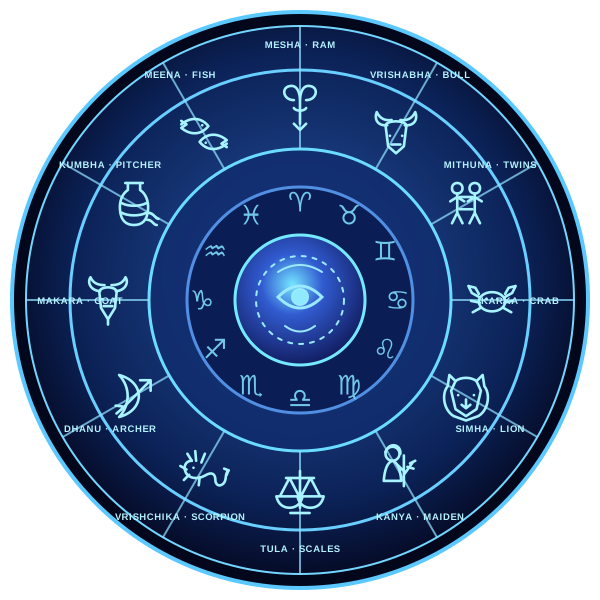
Twelve rashis · One celestial map
SECURE ACCESS
Continue with Google once, or use your email address.
Authentication protected by Clerk · Passwords never reach this app
LEARN VEDIC ASTROLOGY
A Kundli is a map of the sky for a specific birth time and place. In Vedic astrology, the sidereal positions of the ascendant, planets and lunar nodes are arranged across twelve signs and twelve houses to create a structured view of life themes and timing.
It is more than a Sun-sign description: the entire chart is interpreted together. Accurate birth details matter because a time or location change can alter the horizon, house structure and the conclusions drawn from them.
CHART FOUNDATIONS
The zodiac sign rising on the eastern horizon at birth forms the starting point of the chart. It sets the first house and helps describe temperament, physical expression and the way a person approaches life.
Rashi commonly refers to the Moon's sign at birth. In traditional interpretation it is connected with the mind, emotional habits, instinctive reactions and the way a person seeks inner security.
The nine traditional grahas represent different drives and life themes. Their signs, houses, strength and relationships are read together; no graha should be labelled permanently good or bad in isolation.
The Moon's lunar mansion is called the birth Nakshatra. Astrologers use Nakshatras to study temperament, compatibility, recurring emotional patterns and the starting point of Vimshottari Dasha.
Dasha systems divide life into planetary periods. They are used as timing frameworks: the natal chart describes the promise, while the active period is traditionally examined for when a theme may become prominent.
The twelve houses organise the chart into areas such as identity, family, learning, home, relationships, health, work, gains, travel and expenses. House lords connect these subjects with one another.
A yoga is a defined relationship or combination involving planets, signs or houses. A named yoga is meaningful only after its strength, house ownership and the rest of the chart are considered.
Dosha is a traditional label for a chart pattern that may need closer examination. It is not a verdict. Cancellation conditions, planetary strength, timing and the complete chart must be checked before drawing conclusions.
NAVAGRAHAS
These are broad traditional associations, not standalone predictions. Sign, house, lordship, aspects, conjunctions and timing determine how a graha is interpreted.
identity, vitality, confidence and authority
mind, emotions, habits and care
initiative, courage, competition and action
speech, learning, analysis and commerce
knowledge, guidance, growth and principles
relationships, harmony, art and comfort
discipline, responsibility, patience and endurance
ambition, novelty, appetite and unconventional paths
detachment, introspection and spiritual inquiry
TWELVE BHAVAS
Self, body, confidence and outlook
Family, speech, values and accumulated wealth
Courage, communication, skills and siblings
Home, mother, property and emotional foundations
Education, creativity, romance and children
Health routines, service, debts and competition
Marriage, partnerships, clients and public dealings
Transformation, research, inheritance and shared resources
Higher learning, beliefs, mentors and long journeys
Career, responsibility, reputation and public work
Income, networks, gains and long-term aims
Expenses, sleep, solitude, foreign places and release
CHART LAYOUTS
Both layouts can represent the same planetary data. In the North Indian diamond format, houses remain fixed while sign numbers move with the ascendant. In the South Indian rectangular format, signs remain fixed and the houses are counted from the ascendant. KundliJano currently draws the North Indian format.
VARGA CHARTS
Varga charts are derived from the natal chart and used for a closer traditional study of particular subjects. They supplement the D1 chart rather than replacing it.
BALANCED INTERPRETATION
Mangal Dosha, Kaal Sarpa patterns, Pitra Dosha and Sade Sati are widely discussed in traditional astrology. None should be judged from a single placement or used to create fear. Cancellation conditions, planetary strength, the ascendant, relevant houses and the running period must be assessed together.
Traditional remedies may include disciplined conduct, charity, prayer or ritual, but they are personal practices—not substitutes for professional healthcare, legal help or financial planning.
KUNDLI MILAN
The Ashtakoota method compares eight compatibility factors for a total of 36 points, and 18 is often treated as a traditional baseline. A complete compatibility reading also considers emotional patterns, the seventh house, Venus and Jupiter, Mangal Dosha, Navamsa and the timing periods of both people.
A high score cannot guarantee a successful relationship, and a lower score does not prove that a relationship will fail. Communication, consent, shared values and lived compatibility remain essential.
ACCURACY CHECKLIST
Confirm the date, local time and birthplace from the most reliable record available.
COMMON QUESTIONS
Sign in, enter the birth date, exact local birth time and birthplace, then select Generate Kundli. KundliJano resolves the location and timezone before calculating the North Indian birth chart.
The ascendant moves continuously and the house structure depends on it. An uncertain time can change the ascendant degree and, near a boundary, even the ascendant sign. Use a birth certificate, hospital record or reliable family record whenever possible.
Yes. Time and birthplace affect the horizon and house positions, so people born on the same day can have different ascendants and different house placements.
Yes. Choose New, enter the corrected information and generate the Kundli again. A saved profile can also be selected and its fields adjusted before recalculation.
The current app calculates a Lahiri sidereal D1 birth chart, whole-sign houses, natal planetary positions, a transit chart anchored to the natal ascendant, Shadashtak relationships and selected house-lord transit alerts.
Not yet. Divisional charts and couple matching are explained here for education, but the current generated report focuses on the D1 chart and present transits. We do not present an uncalculated feature as a result.
Astrology is a traditional belief system and is not scientifically validated. Use these interpretations for reflection and education, not as a replacement for medical, legal, financial or mental-health advice.